• Skip to main content
  • Skip to footer

Cabin Mama Humor

Humor and woodsy wisdom by Laura Lollar

  • About
  • Articles
    • Archives
  • Books
  • Notecards
  • Subscribe
  • Contact

Black Forest Wildfire

Choosing Recovery: A Wildfire Remembrance

by

It’s been a decade since the Black Forest Wildfire swept through our community, destroying over 14,000 pine covered acres, burning over 500 homes (including ours, see below), structures and killing countless pets and most tragically, two of our neighbors.

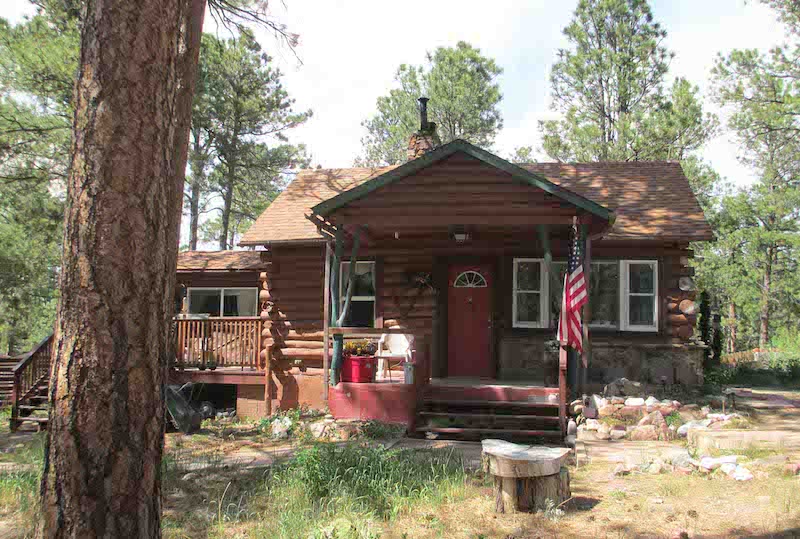
Edith Wolford’s cabin, before the fire:
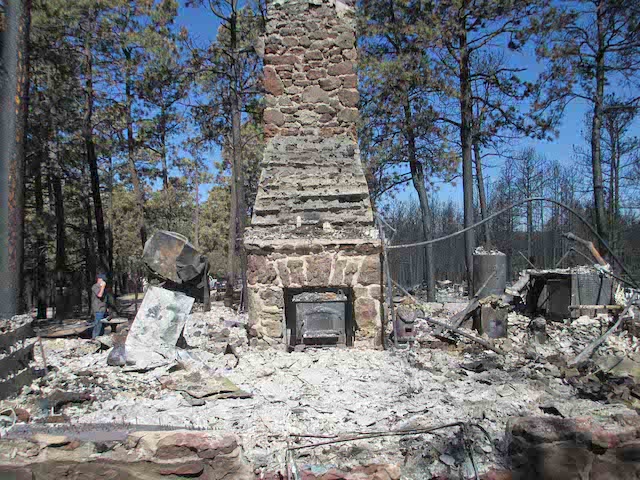
After the fire: an all-too familiar scene
Tragedy manifests itself in different ways. For some, they can’t get past the lifetime of possessions they lost, as well as homes where some raised generations of family members. It may still haunt their dreams. For others, they’ve been able to move past the events of that day and the struggles we all faced to rebuild lives and homes.

We describe life by this one major milestone: “before the fire” and “after the fire” define segments of our lives. Weddings, memorable trips, when we got the new car, etc. are measured against the date of June 11, 2013.

Like chapters in a book, the wildfire is a dog-eared favorite we return to so we can make sense of it all and how the experience changed us. If not for the fire, (as the insurance adjusters often said) how would our lives be different now? What would we not have learned?

The “new normal” wasn’t normal at all. If you rebuilt, you were on familiar land but lived in unfamiliar settings. It was eerie; like living in an episode of the Twilight Zone. We got used to our new surroundings and memories of the old walls began to fade. Now, when we flip through old photos, it’s like looking back at another lifetime.

For some, tragedy struck twice with a new house fire, a serious health problem, an injury or death of someone dear. The fire was just another traumatic event on top of what folks were already trying to cope with. For others, the experience of rebuilding was filled with insurance and new construction complications that added significant stress to the recovery process. It compounded the experience and doubled the work.

The fire impacted people no matter what their loss, evacuation experience or whether they returned to the Forest or moved elsewhere.

Their reactions now, ten years later?

  • We’ve moved on and just tried to get over it.
  • You don’t get any do-overs in life, so there’s no use in stewing about it.
  • We don’t want to be reminded, so we don’t discuss it.
  • The Waldo Canyon fire took our first home and the Black Forest Wildfire took our second home a year later. We’ve moved back to town for good.
  • It helped me learn that people are what’s most important, not the “stuff” we fill our lives with.
  • We learned you can get through tough times if you take it one step at a time.
  • My neighbor is still struggling with the losses. I try to be there for them.
  • Our home is much nicer now. We miss our old place, but this is a great improvement.

That should be our goal. To aim for improvement, physically, mentally and emotionally in whatever way works best. Few of us have followed the same recovery path.

“We have a choice to make every day,” says Joshua Becker, the author of the Becoming Minimalist blog and numerous books.

I would ask, do we choose to move on and create a new life, or do we choose to carry negative experiences around our neck like an emotional boulder?

We always have a choice. Thankfully, the Black Forest community has chosen recovery!

Dealing with Debris from the Black Forest Wildfire

by

Wow! It’s hard to believe so much time has passed. So let me catch you up on the wildfire story. Now we were dealing with debris from the Black Forest Wildfire.

After we viewed what was left of the cabin and my brother’s house, we stopped at the town center where Red Cross folks were handing out shovels, ash sifting screens, tarps and other supplies. What a great group of people. I wish I could have been more sociable, but I felt like I was in a dream — basically pretty numb.

The next few weeks was a blur. I had to meet with the insurance company before any of the debris could be collected or removed. Our adjuster was very thorough and empathetic. He took a ton of pictures and measurements. I had been cautioned not to consider him a friend and keep things professional. Overall, they were fair with us — certainly not Santa Claus — but fair. I had a notebook where I wrote down everything he told me, so I wouldn’t forget. My mind was like a big black hole.

I took advantage of the offer for volunteers from Samaritan’s Purse to sift through the debris for us. The day in July they showed up, it was in the high 90’s and everyone had to wear a hazmat bunny suit for fear of asbestos. Those people were saints! They encouraged Mom and I to sit back under the shade and let them do the work. Every once in a while a volunteer would bring over a “treasure” they’d found to show me. They asked where any important items might have been located in the house and stacked everything they found in piles. They raked the mounds of ash into piles was well.

They were dripping wet under those hazmat suits. And at the end of the day we formed a circle in prayer. They gave me a Bible, which each one of them had signed. They stressed they weren’t doing this work so I would donate, but it was something they each felt called to do. Teams of volunteers do this kind of work throughout the nation when there are disasters. I’ll say it again — they are saints!

There was very little left intact after the fire. Many of my depression glass dishes melted together. Our cast iron skillet that had been on the stove was warped. Imagine how hot the fire had to be to do that! My son’s military dog tags survived, as did some teacups and coffee cups, ceramic Christmas angels and ornaments. (Perhaps a spiritual message?) What we saved from the fire fit into three, five-gallon buckets and some of that was broken glassware and oriental blue dishes I thought I might create something with in the future.

One of the most surprising discoveries were the three ceramic decorative houses my Mom and Dad had given me. They were sitting on top of the stone fireplace mantel, totally intact with only the paint bleached from the fire. Just think of all the burning logs and roofing that fell from above when that fire swept through. And these three little houses survived without a scratch on them. I use one of these houses to close my keynote speech entitled the “Wildfires of Change.” Audience members are pretty amazed at how something so fragile could be so resilient. It makes a great analogy for how we humans survive troubling times.

So, you see, going through the fire itself was one hurdle. Then you had the cleanup and all the decisions about what to do with the debris. There was a lot of metal; the wood stove, twisted water pipes, garage equipment, refrigerator, hot water heater, furnace, washer and dryer, stove and the innards from my Mom’s piano (THAT was a big loss). Thankfully a friend volunteered to collect the metal and after his hard work, we took it down to the salvage center where we were astounded by the amount of metal from the fire. The number of burned out cars and trucks alone was amazing.

After that, I could interview and contract with the debris removal guy to haul everything else away. I wanted the place cleaned up as quickly as possible. I wanted the mess gone. The insurance company required me to get bids from three contractors. It was hard to figure out who to go with; I’d never done this before. Once everything was hauled away. I went out there and noticed the stepping stones that formed a path in front of the cabin now led off into an empty space. Perhaps it represented our future — yet to be determined from the absence of our past. 

The last step was tree removal. Fortunately, trees out front on the majority of our property were spared. The fire had only singed them and the Forest Service guy said they’d bounce back. But the trees along the side of the cabin and in the back were “toast.” We had to remove about 45-50 trees, big ones and little ones, haul away the slash, cut up and stack the trunks. My “woodsman” was kind enough to carve a cross with his chainsaw out of one of the bigger trees. These crosses cropped up all over the forest as people cleared their property. It was a sign of hope.

The Black Forest Wildfire Made Us Homeless

by

So we were homeless, thanks to the Black Forest Wildfire.

And now, all of a sudden, the wait was over and there was so much to do. I had to call my other children and let them know the house was gone. I called the insurance company and filed a claim. I had to get organized. I had to find housing. We needed clothes. I had to contact the phone and cable companies. Where would our mail end up? Would my clients be okay if I postponed their work? Did I have to cancel garbage pickup or would that be obvious? So many decisions. So many pieces of one’s life tied up in your home.

The following Monday we went to the Disaster Assistance Center. I resisted at first, not wanting to feel like a Black Forest Wildfire refugee. But my mom went with me and we moved from one station to another, tying up loose ends, talking to people who’d learned from the fire the year before. I collected paperwork, a stuffed animal, a blanket and lots of data dumped into the big black hole my mind had become. I asked the same questions over again, unaware they’d already been answered.

By Wednesday, we’d found a place to live, thanks to my daughter and a friend whose dad had a rental available. There were 500 families looking for places to live, so we were so lucky to find something just miles from my folks and the property. The insurance company sent us an advance to get clothes, beds and kitchen basics. I’ve never hated shopping to much. I purchased a plastic filing tub to store all the papers. I started a journal and created a “Breadcrumbs” book where I wrote down events as they happened.

The day we went back to the site was surreal. I braced myself for an emotional onslaught and family members insisted we drive out together so I wouldn’t have to face it alone. I remember looking at the debris, the burned out rubble and upright chimney as if it were someone else’s place. We took pictures and poked through the ashes to find a few remains. And I kept waiting to feel something. I didn’t know why I wasn’t having a reaction.

But when we drove to my brother’s house, it hit me. The scene was so ugly. There was a rabbit caught in the fire and “frozen” in place standing up. Imagining that moment for the rabbit did me in. I wanted to get out of there. I felt sick. So I crawled back into the van and waited for the others, tears burning. My son was struggling too. I felt a strange bit of comfort knowing it wasn’t just me, over-reacting. We were in this together he and I. When we finally left and drove through the neighborhood, almost every house was burned to the ground. Taking pictures felt like such a desecration.

“Put one foot in front of the other,” my Mom and Dad kept saying. The steps to come would prove to be the hardest.

© 2024 - Laura Lollar - All Rights Reserved

  • Home
  • LauraLollar.com

Terms and Conditions